

Book of abstracts
Download the book of abstracts of ISMEC 2025:
Scientific program
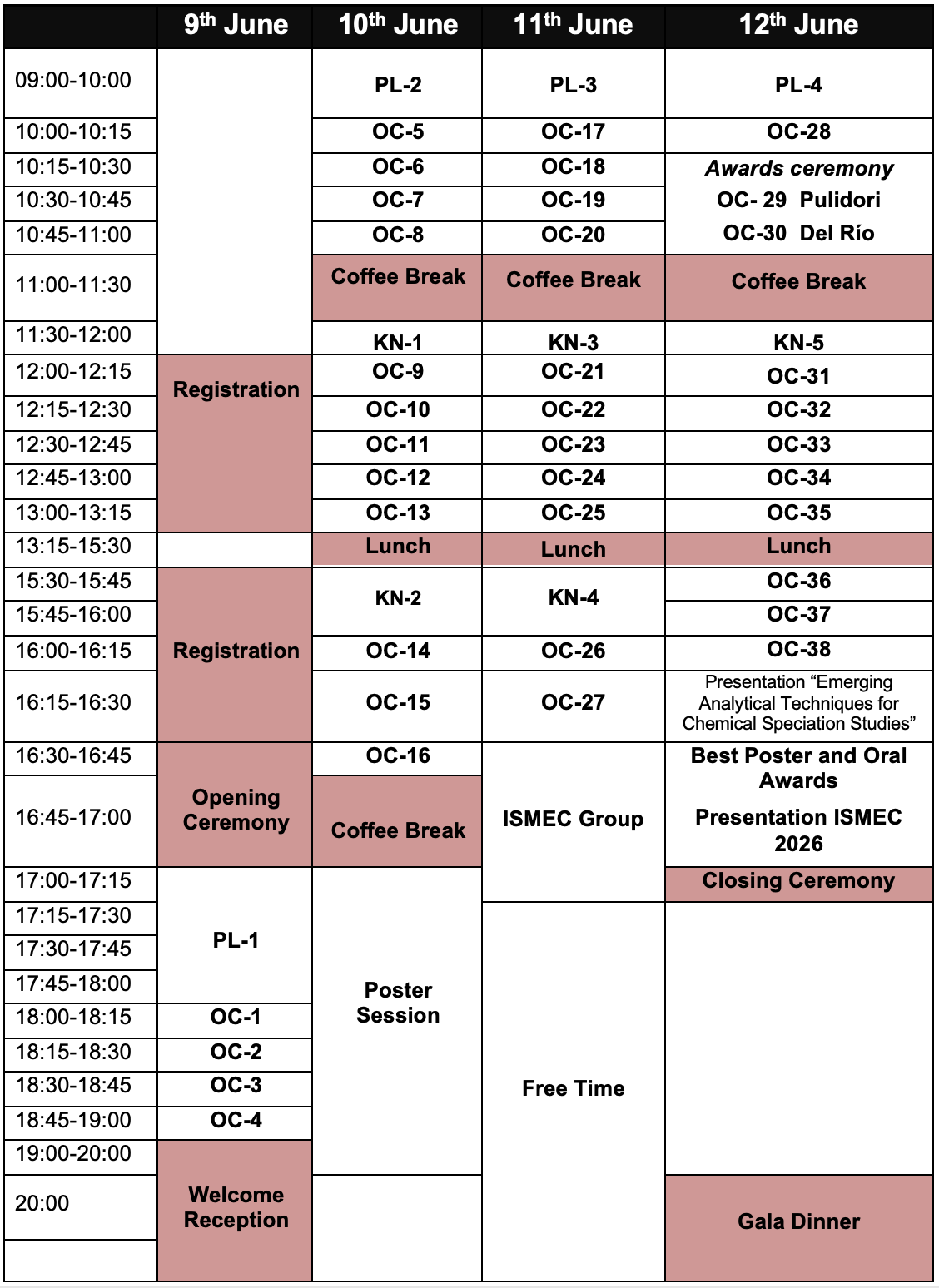
Plenary lectures
Plenary Lecture 1: “Bioinorganic Perspectives on Metallophores: Unlocking New Strategies Against Antimicrobial Resistance”
Henryk Kozłowski. Faculty of Chemistry, University of Wrocław, Poland.
Plenary Lecture 2: “Metal complexes for biomedical imaging”
Eva Jakab Toth. Centre of Molecular Biophysics, CNRS, Orléans, France.
Plenary Lecture 3: “Uranium: Its Theoretical and Experimental Speciation from Mining Operations to the Environment”
Pascal Reiller. Atomic Energy and Alternative Energies Commission | CEA · Département de Physico-Chimie, France.
Plenary Lecture 4: “Anticancer drugs based on metal complexes of 2-imine-8-hydroxyquinolines”
Isabel Correia. Centro de Química Estrutural and Departamento de Engenharia Química, Institute of Molecular Sciences, Instituto Superior Técnico, Lisboa, Portugal.
Keynote lectures
Keynote 1: “Metal ions in ionic liquids: from fundamental studies to applications”
Andrea Melchior. Polytechnic Department, Chemical Technologies Laboratories, University of Udine, Italy.
Keynote 2: “Multi-scale and multimodal imaging of trace elements combining NanoSIMS and Synchrotron techniques”
Iris H.Valido. Department of Chemistry, Faculty of Science, Universitat Autònoma de Barcelona, Spain.
Keynote 3: “Structural and optical properties of DNA-stabilized silver nanoclusters”
Tom Vosch. Department of Chemistry, University of Copenhagen, Denmark.
Keynote 4: “Thermodynamic insights into metal complexes with kojic acid-based ligands: a journey through key results and evolving perspectives”
Rosita Cappai. Department of Chemical, Physical, Mathematical and Natural Sciences, Sassari, Italy.
Keynote 5: “Enhancing the anti-oxidant power of Superoxide Dismutase and Catalase mimics”
Salvador Blasco. Departamento de Química Inorgánica, Instituto de Ciencia Molecular. Universidad de Valencia, Spain.
Oral communications
OC-01: “Antimicrobial actions of zinc oxide microcrystals: from design… to ‘’ziotape’’”
Claudia Pellerito. Department of Physics and Chemistry-Emilio Segrè, University of Palermo, Italy.
OC-02: “The hydrolytic stability of the human tubulin α 1A protein fragment – a potential reason for the role of metal ions in the development of neurodegenerative diseases”
Balázs Sándor. Department of Inorganic and Analytical Chemistry, University of Debrecen, Hungary.
OC-03: “Metal-induced amide deprotonation and binding of model peptides to Cu(II), Zn(II) and Fe(II) metal ions”
Silvia Leveraro. Department of Chemical, Pharmaceutical and Agricultural Sciences, University of Ferrara, Italy.
OC-04: “Elucidating coordination chemistry of the peptidic models of putative Fe(II)-binding sites in bacterial transporter FeoB”
Bartosz Orzeł. Faculty of Chemistry, University of Wrocław, Poland.
OC-05: “Tailoring Synthetic Siderophores for Precision Pathogen Targeting and Molecular Imaging Applications”.
Elżbieta Gumienna-Kontecka. University of Wroclaw, Wroclaw, Poland.
OC-06: “PEG-grafted Metal-organic Frameworks for Imaging: The key parameters for robust synthesis of stable nano-formulations”.
Maria Amparo Lopo-March. University of Valencia, Institute of Molecular Science, Paterna, Spain.
OC-07: “DACH-based hexadentate ligands for Pb2+ complexation: towards applications in nuclear medicine”.
Jennifer StorchI. Department of Chemical and Geological Sciences, University of Modena and Reggio Emilia, Modena, Italy.
OC-08: “Influence of Ligand Topology on the Physicochemical Parameters of Rare-Earth Metal Complexes of OCTAPA Derivatives”.
Balázs Szilágyi. Department of Physical Chemistry, University of Debrecen, Hungary.
OC-09: “Ferrocene-containing ionic liquids as catalysts of ring-opening polymerization”.
Jan Honzíček. Institute of Chemistry and Technology of Macromolecular Materials, University of Pardubice, Czech Republic.
OC-10: “From Solution Equilibria to Photocatalytic Hydrogen Evolution: Exploiting Thermodynamics Concepts in Contemporary Catalysis”.
Matteo Savastano. Department for the Promotion of Human Science and Quality of Life, University San Raffaele Roma, Italy.
OC-11: “Heme vs. Cobalamin, Iron vs. Cobalt – and Beyond: Rationalization of Differing Reactivity in Redox and Coordination”.
Radu Silaghi-Dumitrescu. Babes-Bolyai University, Cluj, Romania.
OC-12: “Tailoring antioxidant activities: Metal-type dependent, highly efficient SOD or catalase mimetics”.
Álvaro Martínez-Camarena. Departamento de Química Inorgánica, Universidad Complutense de Madrid, Madrid, Spain.
OC-13: “From enantiomeric exchange to antimicrobial activity: the enzymatic secrets of salivary peptides”.
Anna Ślusarczyk. Faculty of Chemistry, University of Wrocław, Poland.
OC-14: “Formation, decomplexation and isomerisation mechanisms of lanthanide (III) complexes of 18-py2N4Ac4 (H4pyta): a large macrocycle for large metal ions.”
Petr Hermann. Department of Inorganic Chemistry, Faculty of Science, Univerzita Karlova, Czech Republic.
OC-15: “Structural diversity in zinc(II) complexes with substituted adamantane-1-carbonyl-N-hydrazinecarbothioamides”.
Natalia Alvarez. Química Inorgánica, Departamento Estrella Campos, Universidad de la República, Montevideo, Uruguay.
OC-16: “Self-Assembly Interactions of pyridyl functionalised btp ligands with d– and f– metals”.
Niamh Anne O’Shea. Trinity Biomedical Science Institution, Trinity College Dublin, Ireland.
OC-17: “Bioaccumulation and speciation of Cobalt in Mytilus galloprovincialis: insights into metal-biomolecule interactions in a marine sentinel organism”.
María Rosa Beccia. Université Côte d’Azur, CNRS, Institut de Chimie de Nice, France.
OC-18: “Recovery of neodymium and praseodymium from waste magnet via solid phase extraction with natural zeolite”.
José Alejandro Ricardo García,. Dipartimento Politecnico, Università di Udine, Chemical Technologies Laboratories, Italy.
OC-19: “Environmental applications of biologically active transition metal complexes”.
Giampaolo Barone. Dipartimento di Scienze e Tecnologie Biologiche, Chimiche e Farmaceutiche, Università degli Studi di Palermo, Italy.
OC-20: “Complexation and Precipitation Equilibria in the Cadmium(II) – Nicotinic Acid System. A Potentiometric, Spectrophotometric and 113Cd – NMR study”.
Anna Sofia Sammarco. Department of Chemistry and Biology, University of Salerno, Fisciano (SA), Italy.
OC-21: “How reliable is the evaluation of DNA binding constants? Insights and best practices based on an inter-laboratory fluorescence titration study”.
Tarita Biver. Department of Chemistry and Industrial Chemistry, University of Pisa, Italy.
OC-22: “Ni(II) Cylinder Preferentially Binds DNA Three-way Junctions Blocking DNA synthesis and Triggers DNA Damage in Cancer Cells”.
Jaroslav Malina. Czech Academy of Sciences, Institute of Biophysics, Czech Republic.
OC-23: “Syntheses and metal ion binding strengths of novel ambidentate ligands to construct anticancer drug candidates with hypoxia activation”.
Péter Buglyó. Department of Inorganic & Analytical Chemistry, University of Debrecen, Debrecen, Hungary.
OC-24: “Novel ruthenium (II) polypyridyl complexes: synthesis, interaction with mitochondrial G-Quadruplexes and biological activity in HCT116 human colorectal cancer cells”.
Laura Marretta. University of Palermo, Department of Biological, Chemical and Pharmaceutical Sciences and Technologies, Palermo, Italy
OC-25: “Silver-binding to DNA containing 7-deazapurine nucleobases”.
Antonio Pérez-Romero. Departamento de Química Inorgánica. University of Granada, Spain.
OC-26: “From scratch to speciation: exploring the aqueous coordination chemistry of 2-(aminomethyl)-quinolin-8-ol”.
Matteo Marafante. Dipartimento di Chimica, Università di Torino, Italy
OC-27: “Host-guest complexes in aqueous solution: insights on the molecular recognition properties of carboxylato-prism[n]arene containers”.
Giuseppina D. G. Santonoceta, Department of Chemical Sciences, University of Catania, Viale A. Doria 6, 95125 Catania, Italy.
OC-28: “Metal Ions And Peptides – A Bioinorganic Symphony or Antimicrobial Action”.
Magdalena Rowińska-Żyrek. Faculty of Chemistry, University of Wrocław, Wrocław, Poland.
OC-29 Fernando Pulidori Award: “Master Survival Strategy: Aspf2 zincophore and ZrfC transporter on the front line in the battle for the host’s Zn(II)”.
Kinga Garstka-Litwin. Faculty of Chemistry, University of Wrocław, Poland
OC-30 Andrés M. Del Río Award: “Solar-thermal energy release in a water-soluble push-pull norbornadiene-derivative triggered by a Co(II)-porphyrin complex”.
Franco Castro. Área Química Inorgánica, Departamento Estrella Campos, Facultad de Química, Universidad de la República, Montevideo, Uruguay.
OC-31: “Electrochemical synthesis of cluster helicates with biomedical potential”.
Sandra Fernández-Fariña. Departamento de Química Inorgánica, Facultade de Química, Universidade de Santiago de Compostela, Spain.
OC-32: “Peptide Inhibitors of Metalloproteinases: Structural Insights into Complexes with Zinc and the Catalytic Domain”.
Sławomir Potocki, Faculty of Chemistry, University of Wroclaw, Poland.
OC-33: “Comparing the Bioinorganic Chemistry of MUC7 Fragment and Its Peptidomimetics: Distinct or Similar?”.
Klaudia Szarszoń. Faculty of Chemistry, University of Wrocław, Poland
OC-34: “Peptide-Based Inhibitors Targeting MMP for Cancer Suppression: Thermodynamic and Structural Insights into Zn(II)-MMP-Inhibitor Ternary Complexes.”
Paulina Potok. Faculty of Chemistry, University of Wroclaw, Wroclaw, Poland.
OC-35: “Exploiting Knowledge from Solution Chemistry to Search for Research Funding”.
Manuel Valiente. Universitat Autònoma de Barcelona. Departament de Química. Centre GTS, Spain.
OC-36: “PyES 2.0 – a solution to optimize stability constants from potentiometric data with unique features”.
Silvia Berto. Dipartimento di Chimica, Università di Torino, Torino, Italy.
OC-37: “Potentiometric investigation of solution equilibria in the Sn2+-H2O-F– system using Glass membrane, Fluoride Ion-Selective and Sn(Hg) amalgam electrodes”.
Mariacristina Bianco. Department of Chemistry and Biology, University of Salerno, Fisciano (SA), Italy
OC-38: “Dirhenium(III) clusters of biological interests”.
Nataliia Shtemenko. Instituto de Ciencia Molecular (ICMOL), Universitat de València, Paterna, Spain.
Posters
P-01 Maria KOZURKOVA. Silver(I), Zinc(II) and Gallium(III) tiophene-2-carboxylates: HSA binding and thermodynamics study.
P-02 Silvia BERTO. Design and redox properties characterization of metal/tetrabranched peptide adducts as possible superoxide dismutase mimics.
P-03 Eleonora MACEDI. Fluorescence selectivity through structural modifications: new HNBO- and HBO-based chemosensors for metal cations in solution.
P-04 Giuseppina D. G. SANTONOCETA. Quantitative analysis of exosome-antibody interactions for optimizing molecular recognition in liquid biopsy.
P-05 Hana KOSTRHUNOVA. Antitumor platinum(II) complex 56MESS binds to DNA G-quadruplexes, downregulates expression of c MYC and k-RAS oncogenes, and triggers DNA damage in cancer cells.
P-06 Sofia SHARKAWY. The Effect of Novel Benzothiazole-1,2,3-thiazole Based Arene Osmium(II) Complex on Rhabdomyosarcoma Cells.
P-07 Nicolás VEIGA. Fe(III)-loaded imprinted polymers: towards new catalytic materials for dye pollutant degradation.
P-08 Lisa Rita MAGNAGHI. Dispelling the myth of metal ions contamination in waste: making horse hoof trimming upcycling safe and sustainable.
P-09 Mónica GONZÁLEZ-QUINTELA. Selective recovery of heavy metals from wine sludge using oxidizing agents: towards sustainable waste management in viticulture.
P-10 Raffaela BIESUZ. From solution equilibria to 360° shelf-life: acid-base chemistry on act in freshness-sensing naked eye arrays.
P-11 José L. BARRIADA. The acid-base behaviour of dissolved organic matter in aquatic systems associated to Mero and Ebro rivers (Spain).
P-12 Michel MEYER. Intercomparison Study of DGT Devices with Dihydroxamate-Based Binding Gels for Uranium(VI) Sampling in Freshwater.
P-13 Faareha MAZHAR. Metal binding ability of tau (289-300) fragment.
P-14 Gomaa E. AMER. Effect of Phosphorylation of Serine on the Complex Formation Process of Tau Protein Fragments.
P-15 Katalin VÁRNAGY. Effect of threonine on the interaction between transition metal ions and tau protein fragments.
P-16 Jesús ESCOBAR. Coordination Chemistry of Transition Metal Ions with a Macrocyclic Pyridinic Ligand Containing Mixed N/S Donor Atoms.
P-17 Esther NAVARRO-BLASCO. Self-Assembled Hydrolytic Metallocages with Heterocyclic Diamines.
P-18 Camila CAZORLA-ARES. Method development of a simple digestion method for plant samples with applications in copper phytoremediation studies.
P-19 Juan NICLÓS-GUTIÉRREZ. Solution chemistry, molecular recognition, life and biodiversity, seen by the eyes of a child from the Moon!
P-20 Ahmed Jalil AL-SAFI. Interaction between novel, ambidentate hydroxy-pyridinone derivatives and platinum group metal ions.
P-21 Mª Luz GODINO-SALIDO. Palladium nanoparticles supported on non-covalently functionalized graphene nanoplatelets: Preparation, characterization and study of their catalytic properties.
P-22 Denise BELLOTTI. Thermodynamic and spectroscopic analysis of peptide-based enzyme mimics containing the ATCUN site.
P-23 Jakub GAWŁOWSKI. Effect of enantiomeric modification on the coordination and antimicrobial properties of Clavanin C.
P-24 Emilia DZIEŃ. Histatins in action: exploring the relationship between coordination chemistry, stability and antimicrobial activity of salivary peptides.
P-25 Julianna WOJDYŁA-PARAT. Unusual Chaperonins of Pathogenic Mycobacteria: Correlation between Coordination Chemistry, Structure, Dynamics, and Biology.
P-26 Martyna ZAWADA. Engineering peptide inhibitors to target zinc-dependent bacterial metallopeptidases.
P-27 Zuzana VARGOVÁ. Selected silver(I) complexes: aqueous speciation, structural features, stability and bioevaluation.
P-28 Daniele PADERNI. Adding fluorescent properties to Malten: coordination and preliminary biological studies on two fluorescent derivatives.
P-29 Csilla KÁLLAY. Interaction of salane-type compounds with transition metal ions.
P-30 Delfina QUIÑONE. Fluorescent imprinted polymers: promising probes for fluoride sensing in water.
P-31 Sofia GAMA. Xanthurenic Acid as a Metal Ligand: Insights from Comparative Analysis of Tryptophan-Derived Metabolites.
P-32 Clemente Bretti. Modelling the solubility and the acid-base properties of 3,4-pyridinedicarboxylic in aqueous media and binding ability towards some metal cations.
P-33 Nóra Ildikó KOVÁCS. Complex forming capabilities of ambidentate hydroxy-pyridinone derivatives bearing N-heteroaromatic ring.